Why a 3-ton forklift cannot lift every 3-ton load
Table of contents
- 13-Ton forklift capacity depends on the load centre
- 2Forklift Load Centre: Why Longer Loads Need a Capacity Check
- 33-Ton forklift load examples: Pallets, blocks and machinery crates
- 4Lift height and attachments also change forklift capacity
- 5Browse Toyota and Doosan forklifts on Makana
- 6FAQs About 3-Ton Forklift Capacity
A buyer may see a 3-ton forklift and assume it will comfortably handle any 3-ton job. In practice, two forklifts in the same class can behave very differently once the load gets longer, the rack gets higher or an attachment changes the setup.
That is why forklift buyers should ask about the load itself, not only its weight. A compact pallet of blocks, a long machine crate and a bundle of steel can all lead to different buying decisions even when they sit in the same general weight range.
3-Ton forklift capacity depends on the load centre

Take two forklifts often considered together in the UAE market. The Toyota 8FDU30 is a diesel forklift rated at 2,700 kg at a 610 mm load centre. The LPG-powered Doosan G30NXP is rated at 3,000 kg at a 500 mm load centre. Both are part of the same buying conversation, but the published ratings describe different lifting conditions.
The load centre is the horizontal distance from the fork face to the load’s centre of gravity. A pallet that is 1 m deep has an estimated 500 mm load centre. A 1.4 m-deep crate is closer to 700 mm. The longer load puts more leverage on the forklift, so the usable capacity can fall even when the weight stays the same.
This is why the forklift’s class name is only the starting point. The approved capacity plate and the capacity information for that mast and attachment setup matter far more than the headline number.
Forklift Load Centre: Why Longer Loads Need a Capacity Check
A simple estimate from forklift load-handling guidance helps show the issue. If a forklift is rated at 3,000 kg at a 500 mm load centre, moving the load centre out to 700 mm brings the estimate down to about 2,100 kg. That does not approve or reject a lift by itself, but it does tell the buyer when a normal 3-ton assumption is too loose.
Think of a machinery crate that weighs 2,500 kg and is about 1.4 m deep. Its weight sounds safe on paper, but its length pushes the centre of gravity farther forward. That is exactly the kind of load that deserves a closer look at the capacity plate before you buy the forklift.

Illustrative example only. The chart shows a simple estimate for a forklift rated at 3,000 kg at a 500 mm load centre. Use the approved capacity plate for the final decision.
3-Ton forklift load examples: Pallets, blocks and machinery crates
A few familiar loads make the point more practical. The buyer’s real question is usually not “Can this forklift lift 3 tons?” but “Can this forklift lift our loads at the reach and height we actually use?”
| Load example | Approx. weight | Likely load centre | What the buyer should take from it |
| Block pallet | 2,800 kg | About 500 mm | This is close to the classic 3-ton scenario. The load is heavy, but its shape is compact. Check the plate and the rack height. |
| Machinery crate | 2,500 kg | About 700 mm | The weight is lower, but the longer load may need a closer capacity check or a different forklift setup. |
| Steel bundle | 2,200 kg | About 800 mm | Length and support matter here. The bundle may be lighter than a pallet yet still be harder to handle safely. |
Lift height and attachments also change forklift capacity
A forklift can feel perfectly adequate near ground level, then become the wrong choice once the load needs to go onto a high rack. The approved capacity at 5 m or 6 m may be lower than the capacity near the floor. For warehouse buyers, that detail is more important than the headline lift height on its own.
Attachments matter too. A sideshifter, fork extension or clamp can add weight or move the load forward. The forklift attachment guidance explains why the standard plate for ordinary forks is not enough for every setup.
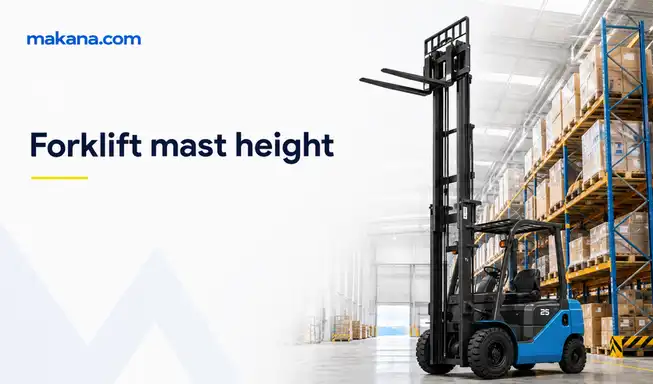
A quick example helps. A 2-ton pallet may be easy to pick up from the floor, but the buying decision changes if the same pallet must be placed at a 6 m rack height or handled inside a container. That is where mast choice becomes important, and our forklift mast height guide explains what to compare.
Browse Toyota and Doosan forklifts on Makana

If you are comparing real machines, start with the model pages and specification pages. Browse the Toyota 8FDU30, review Toyota 8FDU forklift specifications, check the Doosan G30NXP, and browse other Doosan forklift options. You can also explore more used forklifts for sale to see how different mast and fuel configurations compare.
Makana helps buyers compare forklifts in a more useful way than a headline tonnage figure alone. Buyers can review model pages, technical specifications and listing details, then check inspection information, photos and videos where available.
That is especially useful when the job needs a certain mast, a specific fuel type or an unusual handling attachment. If the right setup is not currently listed, you can send the requirement through the machinery procurement service.
FAQs About 3-Ton Forklift Capacity
Can I use fork extensions on a 3-ton forklift?
Only if the extensions are approved for that forklift and load. Extensions can move the load centre forward and reduce usable capacity. Check the manufacturer’s instructions and the updated capacity information before lifting.
Can a 3-ton forklift work inside a shipping container?
It depends on the lowered mast height, free lift, door clearance, tyre choice and load. Diesel or LPG forklifts also need suitable ventilation. Confirm the container dimensions and the forklift’s approved configuration.
Do I need a 3.5-ton forklift for a 2.8-ton pallet?
Not automatically. A compact pallet at low height and a long pallet going onto a high rack are different jobs. Check the rated capacity at the actual load centre and lifting height before choosing a size.
Is an electric forklift better than diesel for indoor storage?
Electric forklifts avoid diesel exhaust at the point of use and are often better suited to enclosed warehouses. Compare charging access, floor conditions, travel distance and the load you need to handle.
What if a used forklift has a missing or unreadable capacity plate?
Do not rely on the model name or an online listing. Obtain the correct replacement plate and capacity information for that forklift and its attachments before putting it into service.