How does a motor grader make a road flat? Blade angle, articulation and wheel lean
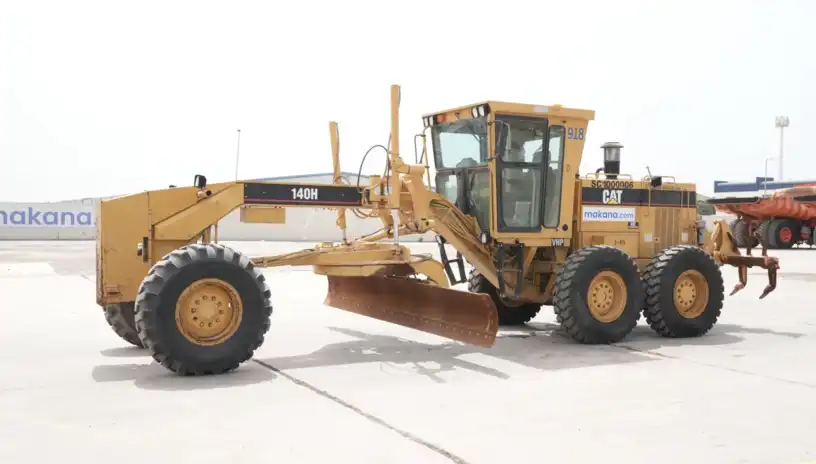
Table of contents
- 1What the motor grader blade actually does
- 2How blade angle moves material across the road
- 3Why graders articulate instead of steering like normal machines
- 4How wheel lean helps the grader hold its line
- 5Rough grading vs final grading
- 6Find motor graders for UAE road projects on Makana
- 7FAQs about motor graders and road levelling
- 7.1Why is the motor grader blade placed in the middle?
- 7.2What is the best blade angle for a motor grader?
- 7.3Why do motor grader front wheels lean?
- 7.4What is the difference between grader articulation and wheel lean?
- 7.5Can a motor grader compact a road?
- 7.6Where can I buy a used CAT motor grader in the UAE?
Watch a motor grader preparing a road and you'll notice three unusual movements. Its blade turns sideways, the machine bends in the middle, and the front wheels lean left or right.
None of these movements is accidental. Each helps the operator control where soil and aggregate go, how the machine travels, and how accurately it follows the planned road level.
And here's the interesting part: a properly graded road is not always perfectly flat. It usually needs a slight slope to drain rainwater.
Let's see how a grader creates that surface, using CAT motor graders as practical examples.
What the motor grader blade actually does

Unlike a bulldozer, which pushes material with a blade at the front, a motor grader carries its main blade, called the moldboard, between the front and rear wheels.
That position allows the operator to see and control the cutting edge while the machine moves over the surface.
The blade can cut a high spot, carry material along its curved face, and release it into a lower area or a windrow for the next pass.
Take the CAT 140M motor grader on Makana. Its 4.27 m moldboard can be raised, lowered, rotated and shifted sideways.
The operator can also adjust the height of each blade end independently. This means one end can cut deeper while the other remains higher, creating a controlled slope across the road.
For example, when preparing a road base, the operator may lower one end of the blade to trim excess aggregate and use the opposite end to distribute material toward the road shoulder.
That ability to change the blade's position while moving is what makes a grader useful for controlling road levels.
How blade angle moves material across the road

Why does a motor grader normally work with its blade at an angle instead of pushing material straight ahead?
Because angling the blade lets material roll along its curved surface and move toward one end rather than building up directly in front of it.
According to Caterpillar's motor grader operating guidance, operators commonly use blade angles between 10° and 45°, depending on the material and the work.
Consider the CAT 140M's 4.27 m blade:
| Blade angle | Approximate effective cutting width |
| 0° | 4.27 m |
| 30° | 3.70 m |
| 45° | 3.02 m |
These are simplified geometric estimates, before allowing for overlap and machine positioning.
At 30°, the blade covers less width than when positioned square to the machine, but it can move material sideways during the pass.
This creates a trade-off. A steeper blade angle helps control the flow of certain materials, while a smaller angle provides a wider cutting path.
Operators also adjust moldboard pitch, which is different from blade angle. Tipping the moldboard forward changes how the cutting edge enters the ground. Tipping it backward can help material roll and spread along the blade.
The combination of angle, pitch and cutting depth determines whether the grader is cutting compacted material, moving a windrow or spreading a thin layer.
Why graders articulate instead of steering like normal machines
A motor grader doesn't rely only on turning its front wheels. Its frame has a hydraulic articulation joint that allows the front and rear sections to move at an angle to each other.
The CAT 140M, for example, has 20° of frame articulation. This helps the machine work around curves, narrow sections and road edges.
But articulation also solves a problem created by the blade itself.
Imagine the grader cutting a heavy windrow of aggregate on one side. The material creates a sideways force, known as side draft, that can pull the machine away from its intended path.
By changing the frame angle, the operator can help counter that force and adjust the machine's position without relying entirely on front-wheel steering.
Articulation is also useful when shaping road shoulders. The front wheels can follow one line while the rear section takes a different position, helping the blade work near the edge.
However, the grader does not need to remain articulated throughout the job.
For ordinary road-maintenance passes, Caterpillar generally recommends keeping the mainframe straight to improve stability. Articulation becomes especially useful when a particular cut, turn or machine position requires it.
How wheel lean helps the grader hold its line
Those tilted front wheels are one of the most distinctive features of a motor grader.
They are not damaged or incorrectly aligned. The operator can deliberately lean them to compensate for sideways forces.
When an angled moldboard moves material to one side, the cutting resistance can pull the front of the grader in the opposite direction.
Leaning the front wheels helps counteract that pull.
For example, if material rolls off the blade to the right, the operator will normally lean the tops of the front wheels toward the right to resist side draft.
This helps the grader follow its intended path instead of continuously drifting sideways.
Wheel lean also provides several advantages:
- Working on slopes: Helps resist sideways movement when grading across uneven ground.
- Cutting drainage ditches: Supports machine positioning while reducing the risk of tyre sidewall contact.
- Making tight turns: Can work with articulation to reduce the turning radius.
- Finish grading: Allows small corrections to the machine's direction.
Caterpillar explains these uses in its motor grader articulation and wheel lean guide.
Wheel lean is not simply another steering control. Its main value is helping the operator manage the forces acting on the front axle while the blade works.
Rough grading vs final grading

A grader may pass over the same road several times, but the purpose changes as the work progresses.
Rough grading prepares the general shape. The operator cuts high areas, redistributes material, fills low sections and forms the approximate road profile. At this stage, the machine may handle larger windrows of soil or aggregate. The goal is to bring the surface close to the required level.
Final grading focuses on accuracy. The operator makes lighter cuts to remove smaller irregularities and establish the required elevations and slopes before compaction or the next construction stage.
Here's an example. Suppose a road is 6 m wide and the design requires a 2% crown from the centre toward both edges. Each edge is 3 m from the centreline. At a 2% slope, the difference in height is:
3 m × 2% = 60 mm
The centre of the road would therefore sit approximately 60 mm higher than each edge, assuming a symmetrical crown.
That small difference helps water drain away from the road centre instead of collecting on the surface. The actual slope depends on the approved road design.
During final grading, the operator must follow the required levels rather than simply make the road look smooth.
Survey stakes, laser systems or compatible grade-control technology can help measure the blade's position against the planned surface.
The grader shapes the material, while suitable compaction equipment provides the required density. One machine does not replace the other.
Find motor graders for UAE road projects on Makana

If your next project involves road-base preparation, drainage slopes or final grading, the blade and control systems deserve as much attention as engine power.
Makana offers used motor graders for sale in the UAE, including different Caterpillar 140-series models.
The CAT 140H and CAT 140K are among the models represented on Makana, alongside the 140M and 140M VHP Plus.
Buyers can compare their moldboard dimensions, operating weights, articulation, engine output and other measurements through Makana's CAT 140 motor grader technical specifications.
When inspecting a used grader, pay particular attention to:
- Moldboard and cutting edges: Excessive wear or damage can affect cutting accuracy.
- Circle and blade controls: Check for excessive play and inconsistent blade movement.
- Articulation joint: Inspect pins, bushings and hydraulic response.
- Front wheel lean: Confirm the mechanism operates smoothly in both directions.
- Tandem drives and tyres: Look for wear, leaks and problems that could affect traction or stability.
Makana provides equipment specifications, 75+ point inspection reports, photographs and operational videos, with additional inspection information depending on the machine.
For road contractors looking for a specific grader model or configuration, the machinery procurement service can also help source suitable equipment.
FAQs about motor graders and road levelling
Why is the motor grader blade placed in the middle?
The central blade position allows the operator to control cutting depth, angle and material movement while the front wheels guide the machine and the rear tandems provide traction.
What is the best blade angle for a motor grader?
There is no single best angle. Caterpillar commonly recommends working within a range of 10° to 45°, depending on material conditions and the task. Blade angle affects both material flow and effective cutting width.
Why do motor grader front wheels lean?
Front wheel lean helps counter sideways forces created by the blade, keeping the machine closer to its intended path. It also assists with slope work and tight turns.
What is the difference between grader articulation and wheel lean?
Articulation bends the machine's frame at its central joint. Wheel lean tilts the front wheels sideways. Both improve control, but they affect machine positioning and stability in different ways.
Can a motor grader compact a road?
A grader shapes and levels the material but does not replace a compaction roller. After grading, suitable compaction equipment is normally used to achieve the required material density.
Where can I buy a used CAT motor grader in the UAE?
Makana offers CAT 140H, 140K, 140M and other used motor graders in Dubai, depending on inventory. Buyers can compare technical specifications, inspection reports and available purchasing options online.